The story of how a $20 million bet on doing good turned into a marketing disaster
The Big Gamble
Picture this. It’s 2010. Pepsi has been running Super Bowl ads for 23 straight years. The Super Bowl is basically the Olympics of advertising. A 30-second spot costs nearly $3 million, and everyone watches it. It’s the one day of the year when people actually want to see commercials.
But Pepsi decided to do something radical. They walked away.
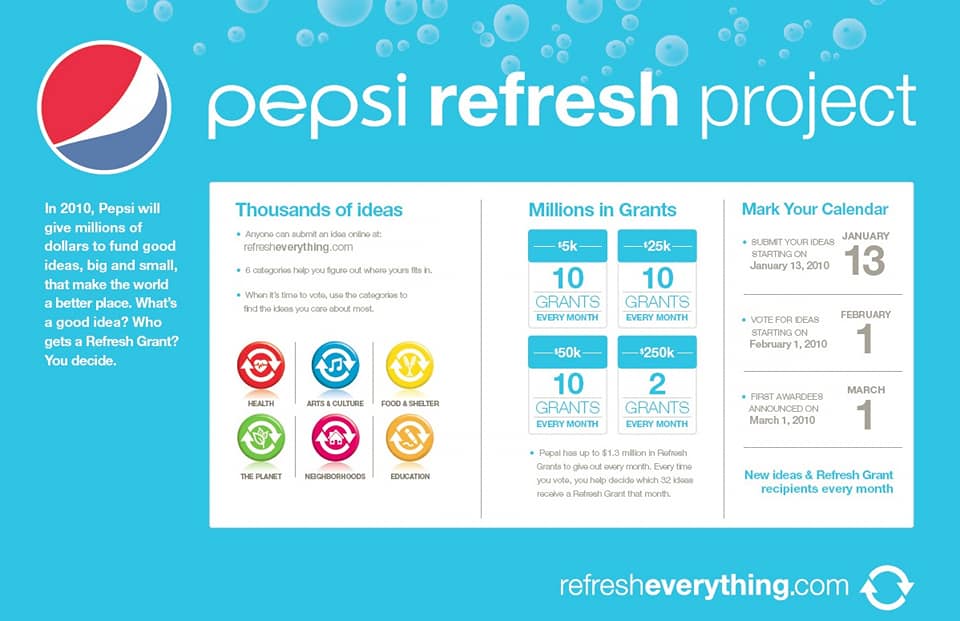
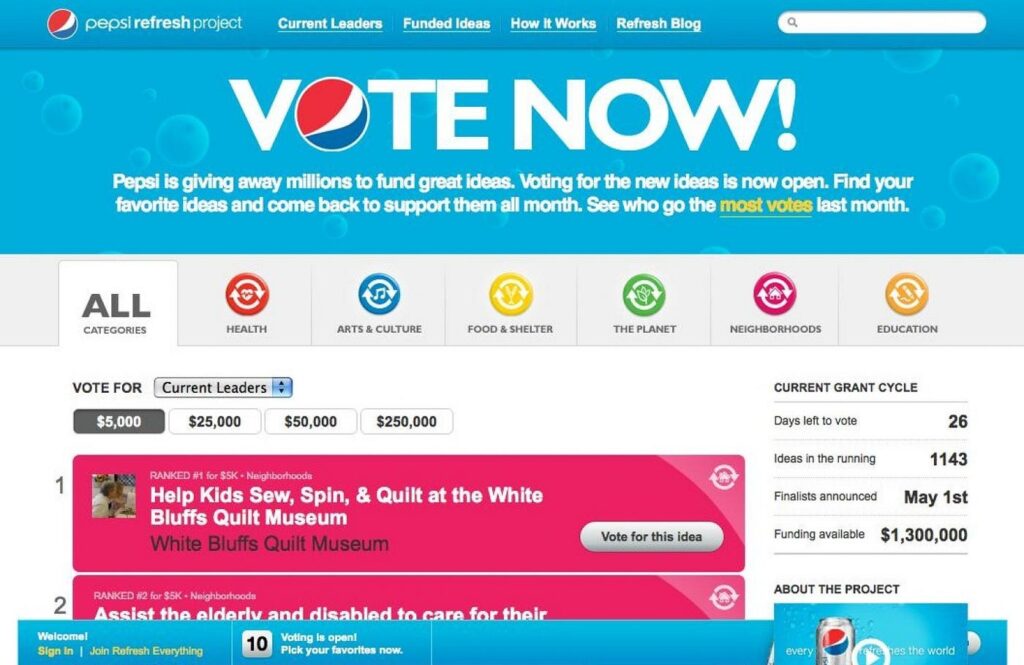
Instead of spending $20 million on Super Bowl ads, they launched the “Pepsi Refresh Project.” The idea was simple and, honestly, pretty noble. They’d give away that $20 million to people with ideas to make the world better. Anyone could submit ideas on refresheverything.com for projects in six categories: health, education, arts and culture, food and shelter, neighborhoods, and the planet. People would vote online, and Pepsi would fund the winners with grants ranging from $5,000 to $250,000.
This wasn’t some small-scale CSR initiative. This was Pepsi betting their entire marketing budget on the idea that doing good would be good for business.
Shiv Singh, Pepsi’s head of digital, called it exactly what it was. “This was a big bet. No one has done it on this scale before.”
The Numbers Looked Amazing
And at first? It seemed to work brilliantly.
The website got flooded. In less than a week, they received 1,000 ideas for January alone. By the time the campaign wrapped up, the numbers were staggering.
80 million votes cast. 18 million unique visitors to the website. 37% of Americans were aware of the project. Over 12,000 projects received votes. Thousands of ideas funded across the country. Even Drew Brees (yes, the NFL quarterback) participated and won a $100,000 grant.
Pepsi became the most talked-about brand during the 2010 Super Bowl despite not running a single ad. Forbes ranked it number 5 in the Best Ever Social Media Campaigns. The media coverage was relentless. Progressive celebrities jumped in. It was a masterclass in getting attention.
Everything seemed perfect. Except for one tiny problem.
Nobody was buying Pepsi.
What Harvard Business School Saw Coming
While Pepsi was celebrating its social media victory, Harvard Business School was quietly turning this into a case study. And not the kind you want.
In 2011, professors Michael I. Norton and Jill Avery published “The Pepsi Refresh Project: A Thirst for Change” as an official Harvard Business School case study. But it wasn’t a celebration. It was an autopsy.
The case study raised three critical questions that Pepsi’s marketing team should have asked BEFORE spending $20 million.
How should we measure ROI?
The HBS case zeroed in on the fundamental problem. How do you evaluate the success of a cause-marketing initiative? By social media engagement? Brand awareness? Or actual sales?
Pepsi chose the wrong metrics. They measured engagement and awareness while ignoring the only metric that actually mattered: whether people were buying more Pepsi.
The case highlighted a crucial tension. You need to balance short-term sales against long-term customer loyalty and brand health. Pepsi bet everything on the long-term play. But in a competitive market where Coke was actively advertising and taking market share, the short-term sales decline killed them.
Does this fit with Pepsi’s brand positioning?
This was perhaps the most damning question in the HBS case. “Is Pepsi the right brand for this kind of initiative?”
Think about it. Pepsi had spent decades positioning itself as the fun, youthful, rebellious alternative to Coca-Cola. The “Pepsi Generation.” The choice of a new generation. Celebrity endorsements. Music. Culture. Energy.
Now suddenly, Pepsi wants to be about community grants? Environmental causes? Educational programs?
The HBS professors noted this jarring disconnect. The Refresh Project didn’t align with Pepsi’s previous brand positioning AT ALL. It was a complete departure from everything the brand had stood for.
If you want to do social good as a brand, that’s admirable. But it needs to connect authentically to what your brand represents. Patagonia can do environmental activism because it’s inherent to outdoor gear. Dove can do body positivity because it relates to beauty products.
But Pepsi doing generic social good? It felt forced. Inauthentic. Like they were trying to buy goodwill rather than earn it.
Should Pepsi have given up control of its brand?
Here’s something most people don’t realize. The Pepsi Refresh Project essentially outsourced brand positioning to consumers.
The HBS case study highlighted the risks of “opening up” a brand to consumer involvement via social media. Pepsi empowered consumers to propose projects for ANY charitable cause they wished. This meant Pepsi relinquished control over the causes it supported.
Think about what this means. Some guy in Idaho could submit a project about fixing potholes. A nonprofit in Oregon could propose an arts program. A teacher in Florida could request playground equipment.
Pepsi’s brand was now associated with everything and nothing. There was no coherent narrative. No clear message. Just a scattered collection of random good deeds.
Compare this to how strong brands maintain control of their narrative. When Nike supports athletes, they choose which athletes and which stories align with their “Just Do It” ethos. When Apple supports education, they do it through products that showcase their design philosophy.
Pepsi gave away the steering wheel and was surprised when the car went off the road.
The verdict from Harvard?
The case study didn’t just document what happened. It fundamentally questioned whether the entire strategy made sense. The three critical questions they raised weren’t answered satisfactorily, and the market results proved it.
This wasn’t celebrated as innovation. It was presented as a cautionary tale about what happens when you confuse engagement metrics with business results, when you abandon your brand positioning for trend-chasing, and when you give up control of your brand narrative.
Harvard Business School literally turned the Pepsi Refresh Project into homework for MBA students on what NOT to do in marketing.
The Brutal Truth
While Pepsi was busy changing the world, Coca-Cola was busy selling soda.
Here’s what happened during and after the Refresh Project.
Pepsi-Cola sales fell 4.8% in 2010. Diet Pepsi sales fell 5.2% in 2010. Pepsi dropped from number 2 to number 3 in the US soft drink market, falling behind both Coca-Cola AND Diet Coke. The brand lost an estimated $350 million in market share value.
Meanwhile, Coke’s sales? They slipped just 0.5%. Diet Coke? Just 1%.
By early 2012, Pepsi quietly killed the Refresh Project. The experiment was over.
But why did this happen? How did a campaign that generated 80 million votes fail so spectacularly?
The Fatal Flaws
They forgot they were selling soda
The Pepsi Refresh Project had almost no connection to the actual product. You didn’t need to buy Pepsi to submit ideas. You didn’t need to buy Pepsi to vote (initially, at least. They later added “power votes” under bottle caps, but by then it was too late).
Compare this to Coca-Cola’s strategy. While Pepsi was talking about saving the world, Coke was running happiness-themed ads. Fun, fizzy, feel-good messages that screamed “Buy this drink and enjoy life.” Simple. Effective. And crucially, about the product.
Too many causes, too little focus
Six broad categories. Hundreds of issues under each. Environmental projects. Education reforms. Healthcare initiatives. Neighborhood improvements.
Pepsi was trying to be everything to everyone. But when you stand for everything, you stand for nothing. The campaign lacked a concentrated message. It was scattered. People didn’t know what Pepsi stood for anymore.
Was Pepsi the fun, youthful brand with celebrity endorsements? Or was it now a social activism platform? The brand identity got diluted.
The voting scandal that killed credibility
In January 2011, the New York Times published an exposé. Turns out, nonprofit organizations were gaming the system. They’d mobilize their donor bases to vote repeatedly, essentially rigging the competition.
Progressive nonprofit coalitions coordinated efforts to sweep the grants. Individual participants didn’t stand a chance against organized groups with resources and databases.
The whole thing started to feel less like “grassroots change” and more like “whoever has the biggest email list wins.” That’s not inspiring. That’s just unfair.
Wrong audience, wrong participants
Pepsi’s target customers are regular individuals who buy sodas at convenience stores and supermarkets.
But the major winners of the Refresh Project? Organizations, foundations, and nonprofits.
There was a fundamental mismatch. The average Pepsi drinker didn’t see themselves in this campaign. They saw big organizations winning grants while they struggled to compete. It created distance instead of connection.
They abandoned proven marketing
The Super Bowl isn’t just an ad. It’s a cultural moment. It’s water cooler conversation. It’s brand building at scale. For 23 years, Pepsi had used this platform to stay relevant.
And they just walked away.
Pepsi essentially chose to conduct a grand social experiment with their marketing budget in the middle of a fiercely competitive market. That’s brave. It’s also potentially reckless.

What Pepsi Got Right
Before we completely trash this campaign, let’s acknowledge what Pepsi actually achieved.
They were genuinely innovative. Nobody had attempted cause-marketing on this scale before. They were the first major brand to abandon the Super Bowl for digital marketing. That takes guts.
They built massive social media presence and digital engagement that most brands would kill for. They proved that social media campaigns could generate attention at scale.
They funded real projects that helped real people. Animal shelters, cancer patient housing, Gulf oil spill cleanup efforts, schools, playgrounds. These grants made tangible differences in communities.
And honestly? The idea wasn’t bad. Consumers do want brands to stand for something. Cause-marketing can work.
But execution matters. And metrics matter even more.
The Real Problem: Wrong Metrics
Pepsi measured success by social media engagement, website traffic, votes cast, ideas submitted, and brand awareness.
These are fine metrics. But they’re micro goals. They missed the macro goal of selling more Pepsi.
They didn’t link customer engagement to sales. Someone could vote daily, share on social media, and never buy a single bottle of Pepsi. And apparently, that’s exactly what happened.
As one analysis put it, “If the brand awareness and customer relationship increases, sales should go higher.” But they didn’t. That disconnect should have been a red flag.
Pepsi proved you can win at social media and lose at business.
What Should Pepsi Have Done?
Here are some alternatives that might have worked better.
Tie purchases to impact
Want to vote? Buy a Pepsi. One bottle equals one vote. Or adopt a Bombas-style model. For every Pepsi sold, we fund a project. This directly links sales to social impact.
Focus on ONE cause
Instead of six categories with hundreds of projects, pick one massive, clear goal. “Pepsi Builds 100 Playgrounds Across America.” Simple. Focused. Measurable.
Don’t abandon traditional advertising
The Refresh Project should have supplemented the Super Bowl ad, not replaced it. Use the big stage to tell the story, then drive people to vote online.
Integrate the product
Make it about the Pepsi experience. “Refresh your world, refresh yourself.” Connect the social mission to the product benefit instead of making them completely separate.
Fix the voting mechanism
Prevent organizations from gaming the system. Make it truly democratic. Or lean into it and make it specifically for nonprofits, being upfront about it.
The Bigger Lesson
The Pepsi Refresh Project failed not because cause-marketing is bad, but because Pepsi forgot the first rule of marketing. Your primary job is to sell your product.
Social responsibility is great. Building long-term relationships is important. But if those efforts don’t eventually translate to sales, you’re just burning money.
Companies exist to create value for shareholders. You can do good AND do well. But if you only do good while your competitors do well, you’ll lose.
Coca-Cola understood this perfectly. They stuck to their happiness-themed advertising, reinforced their core brand message, and kept selling soda. While Pepsi was trying to save the world, Coke was selling the simple joy of drinking a cold beverage.
And in a commoditized market like soft drinks, that consistency matters.
Where Are We Now?
Pepsi learned its lesson. They went back to Super Bowl advertising. They refocused on product-centric campaigns. In 2012, they launched “Live for Now,” a return to their youthful, fun positioning.
But the Refresh Project taught the entire industry something valuable: authenticity matters, but so does alignment.
Cause-marketing works when it’s authentic to your brand and integrated with your business model. TOMS Shoes? One for one makes sense because it’s built into the product. Patagonia’s environmental activism? It aligns perfectly with their outdoor gear brand.
But a soda company positioning itself as a social activism platform? That’s a stretch. It felt inauthentic because the cause wasn’t connected to the core product.
The Final Verdict
Was the Pepsi Refresh Project a failure?
By social media metrics? No. It was a massive success.
By brand awareness metrics? No. It got unprecedented attention.
By business metrics? Absolutely yes. It failed spectacularly.
And ultimately, businesses are measured by business metrics.
Pepsi’s heart was in the right place. The execution was innovative. The scale was ambitious. But they forgot that changing the world is great, as long as you’re also selling soda.
Because at the end of the day, you can’t refresh the world if you can’t refresh your bottom line.